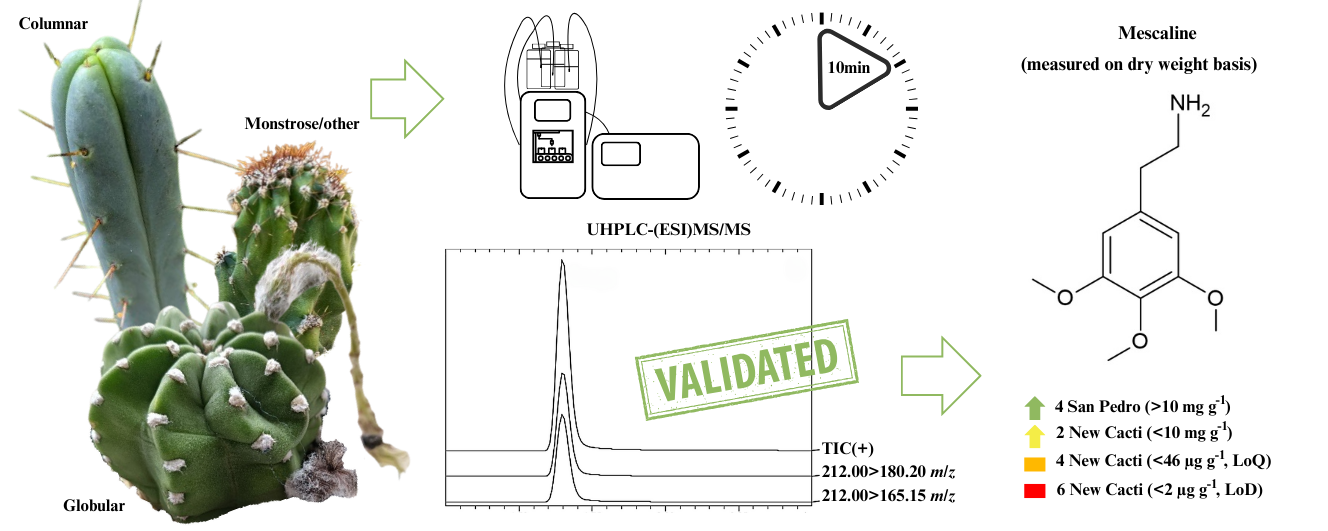
We just published a new paper in Forensic Chemistry about our development of a fast, accurate lab method to measure mescaline levels in cacti.
In simple terms:
UHPLC separates different compounds in a sample based on their chemical properties, and MS/MS detects and quantifies them.
🌵 San Pedro (Trichocereus species)
We tested:
- T. bridgesii ‘Rita’ — about 2.7% mescaline in the skin (chlorenchyma)
➔ 1.4% in the core (parenchyma) - T. bridgesii ‘CLS’ — about 2.7% in the skin
➔ 0.7% in the core - T. bridgesii ‘Experiment’ — about 3.3% in the skin
➔ 1.7% in the core - T. peruvianus ‘Control’ — about 1.6% in the skin
➔ 0.75% in the core - T. pachanoi ‘Predominant Cultivar’ — about 0.5% in the skin
➔ 0.2% in the core
➔ Important: The skin (chlorenchyma) has more mescaline, but the core (parenchyma) still has significant amounts.
The whole cactus contributes to potency, not just the skin.
In some cases, the parenchyma had about half the mescaline concentration of the chlorenchyma — and because the core is the bulk of the cactus, this could double the total mescaline yield!
🌵 Big Discovery in Echinopsis subdenudata
We found mescaline for the first time in Echinopsis subdenudata, a popular ornamental cactus usually thought to be mescaline-free.
- One E. subdenudata var. compacta sample had 0.25% mescaline in spring (main globule)
➔ Dropped to 0.008% in summer - The ‘Fuzzy Navel’ variety had only about 0.0006% mescaline
➔ The amounts are tiny — you’d need hundreds of grams dried to yield a decent dose — but it challenges the idea that globular Echinopsis cacti are always mescaline-free.
🌸 Season and Conditions Matter
Mescaline levels in Echinopsis subdenudata dropped dramatically between spring and summer.
➔ Season, flowering, and stress might affect how much mescaline a cactus makes.
🧪 Why This Matters
- The whole cactus contains mescaline, not just the skin.
- Some common ornamental cacti likely contain mescaline, such as Echinopsis subdenudata — but at extremely low levels.
🌵 Cactus Family Tree Update
The finding could support the idea of combining Trichocereus and Echinopsis into one group.
➔ The old idea — “Trichocereus = mescaline, Echinopsis = no mescaline” — doesn’t hold up.