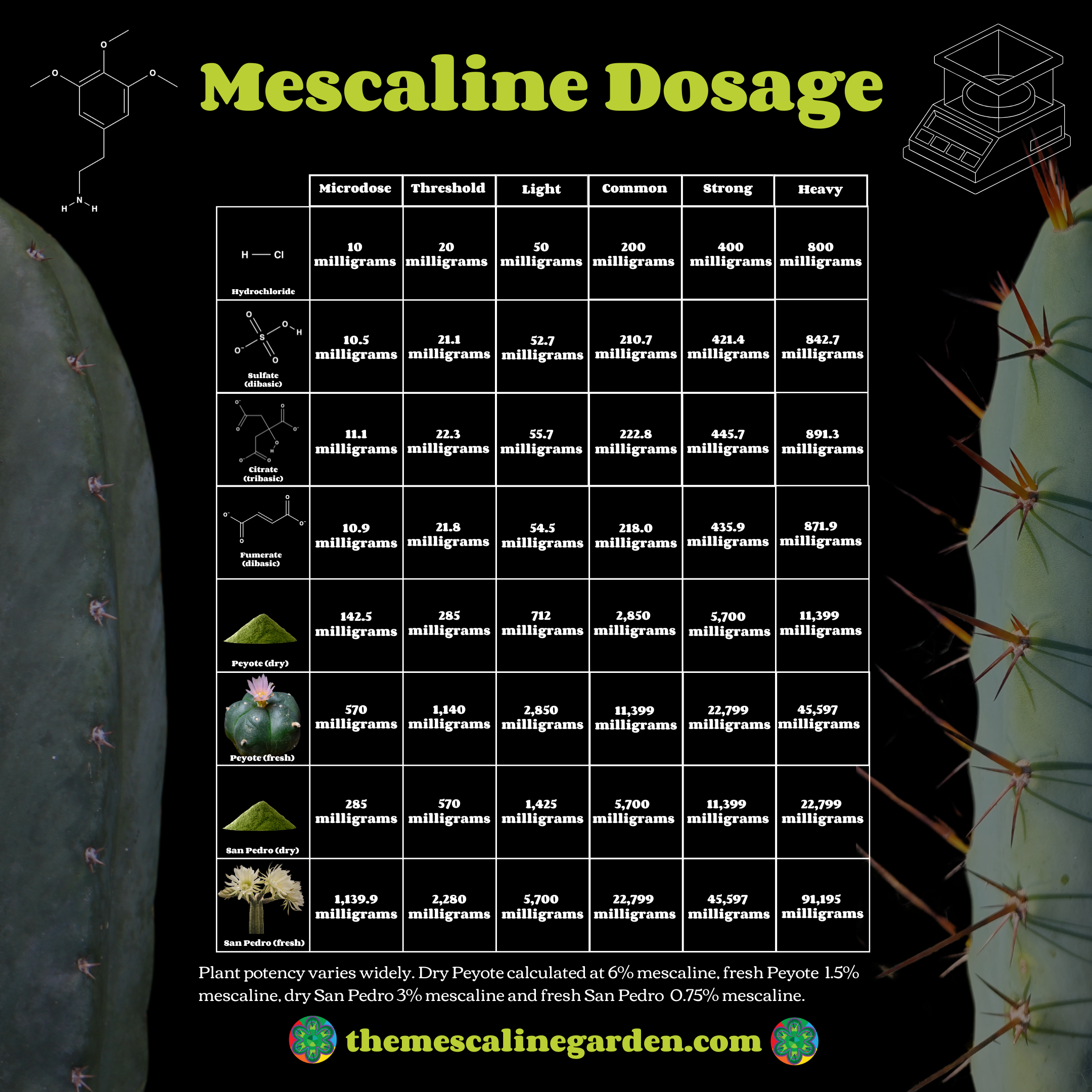
This new resource, much like our Classic Psychedelics: Dosage weights and intensities poster, aims to help people understand and compare the weights of micro, light, common, threshold and strong dosages of common mescaline products. These products are San Pedro and Peyote (fresh and dry) and mescaline salts; citrate, hydrochloride, fumerate and sulfate.
The Mescaline Dosage resource is drawn from a recently published paper by Liam; ‘The Trouble With Psychedelic Cacti: Diverse meanings of San Pedro and Peyote.’ The paper uses an autoethnographic approach to highlight the unique perspectives amongst different mescaline cacti stakeholders. The article highlights the complex questions and ethical challenges presented when trying to engage with these plants. How can we honour traditional knowledge while engaging in new research? How do we navigate the contradiction of advocating for plants while living in a capitalist culture? How do we protect these sacred cacti in the face of commodification, prohibition, and ecological crisis.? We can benefit from learning to think differently about plants—not just as tools for human use, but as beings with their own ecological and cultural presence.